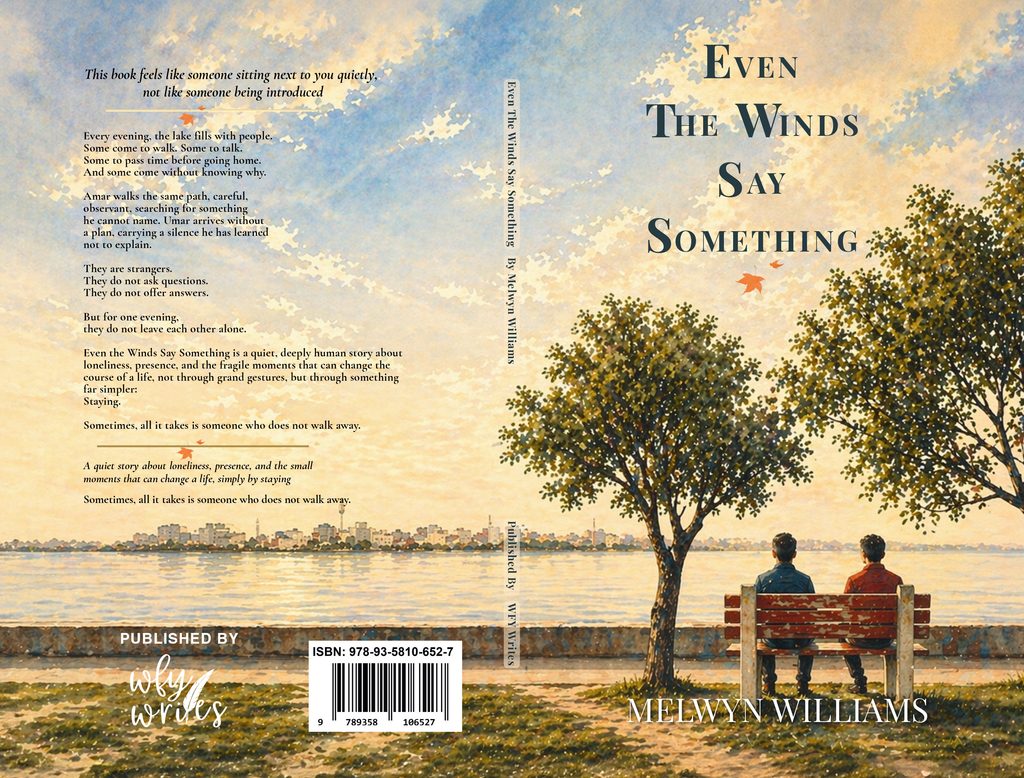
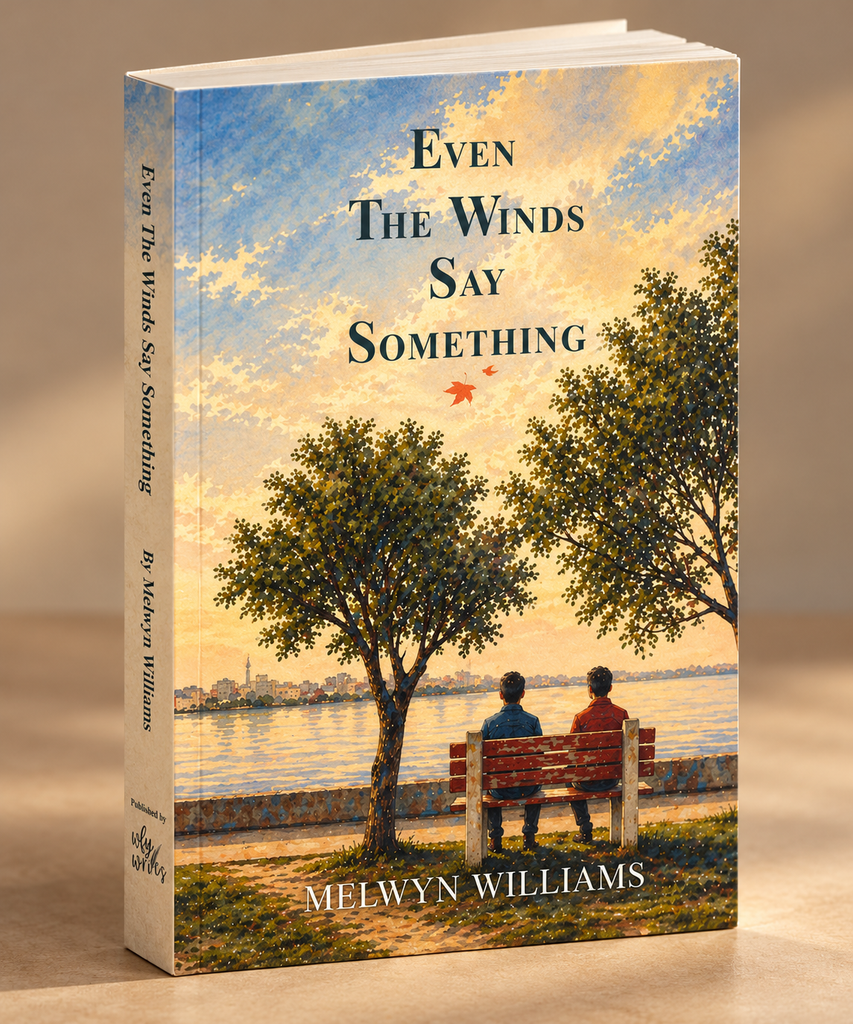
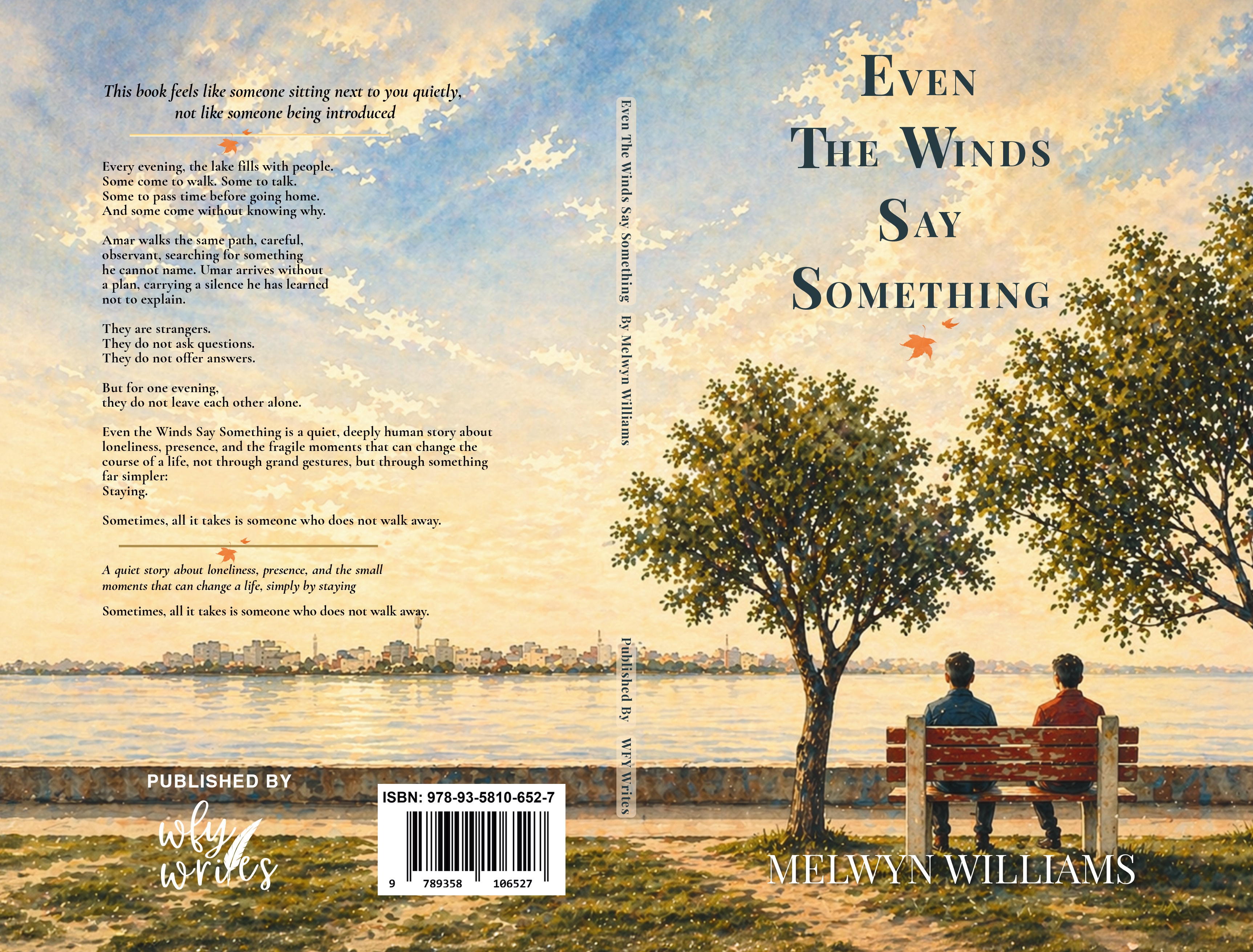
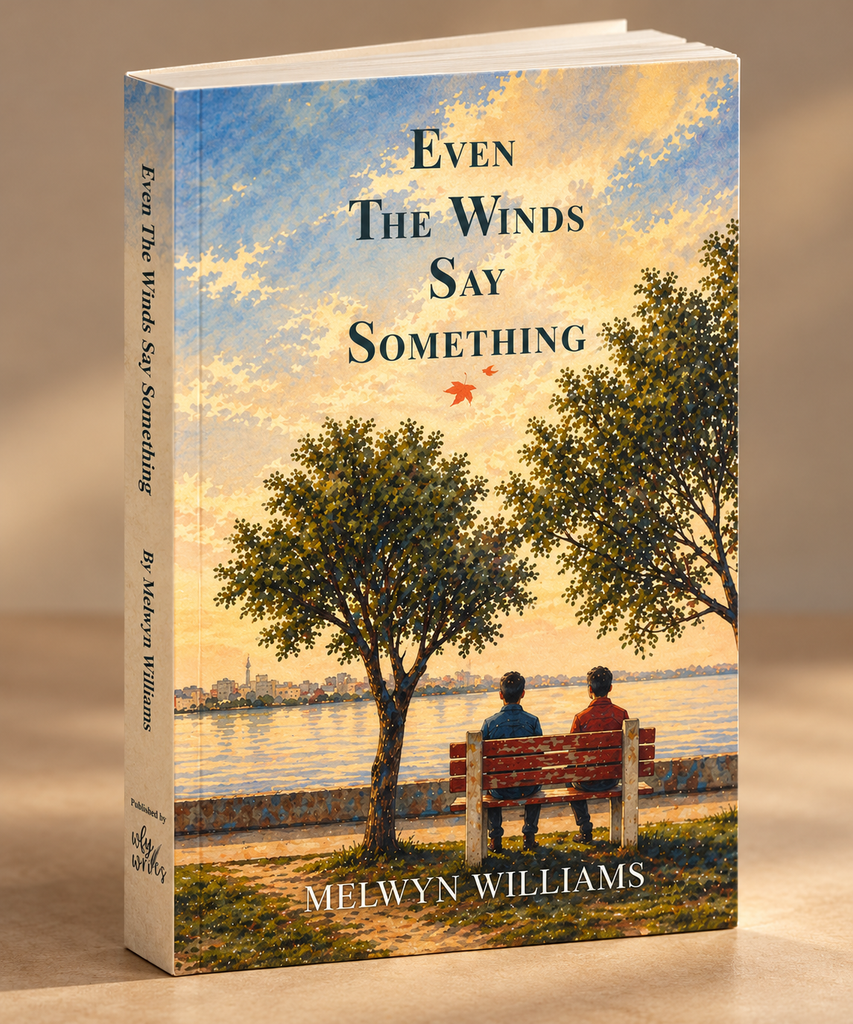
Even the Winds Say Something
By Melwyn Williams
Click to Buy
Published By WFY Writes

Even The Winds Say Something
One evening. One lake. Two strangers who refuse to let the other disappear.

One evening. One lake. Two strangers. An encounter that quietly changes everything.
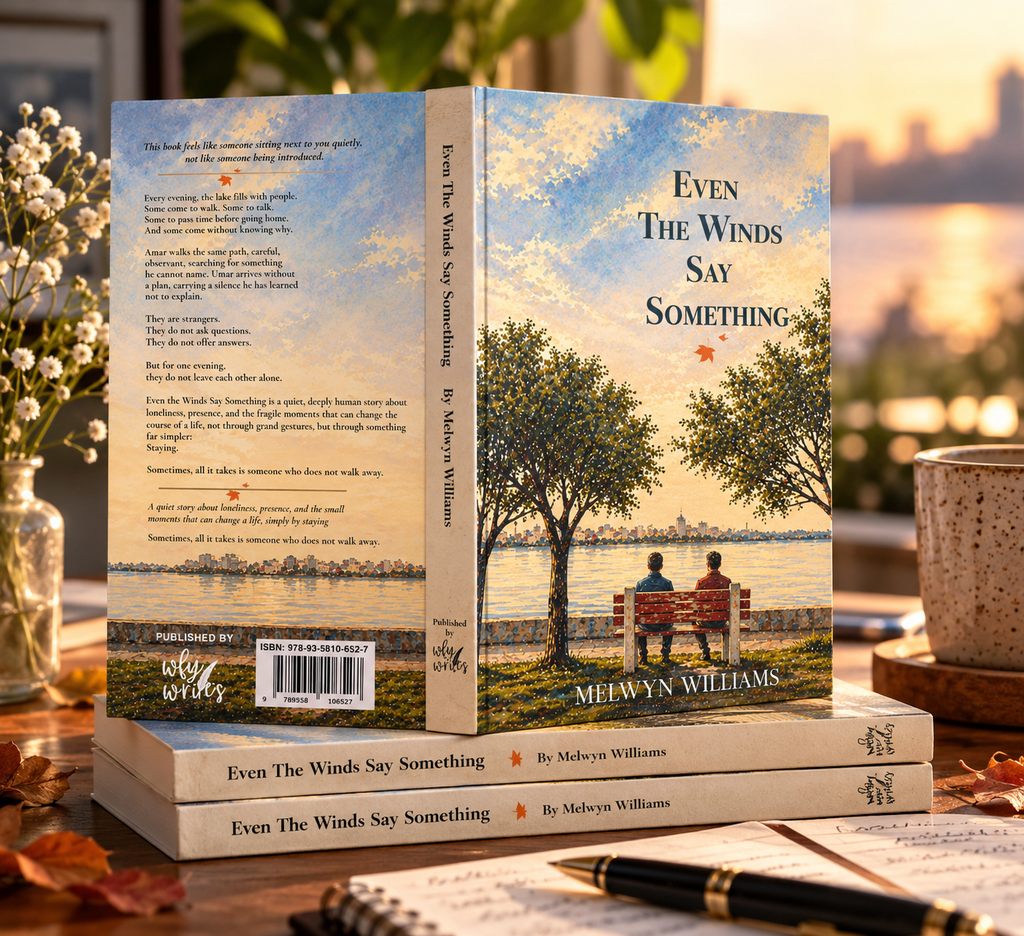
Even The Winds Say Something is a moving literary short story about loneliness, human connection and the extraordinary significance of an ordinary encounter.
Amar Sharma and Umar Khan are strangers when their paths cross beside a quiet lake. They arrive carrying their own private burdens, with little reason to expect that the evening will be different from any other. Neither knows the other’s story. Neither has come looking for friendship.
Yet, as the evening unfolds, an unexpected companionship begins to take shape. Through conversation, silence and the simple experience of sharing a moment, two unfamiliar lives become connected in ways neither could have anticipated.
Written by Melwyn Williams, this reflective story explores the emotions people often conceal, the distances that separate individuals and the quiet possibilities that emerge when someone chooses to remain present.
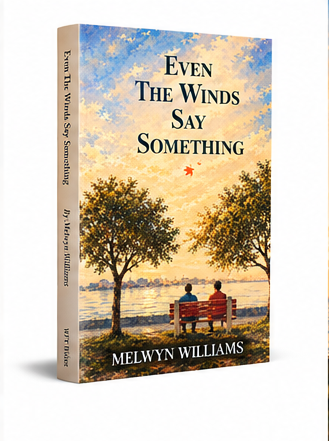
Accompanied by evocative colour illustrations, Even The Winds Say Something invites readers to consider the importance of empathy, understanding and companionship in a world where loneliness can remain invisible even among those around us.
Sometimes, the most meaningful difference we make in another person’s life begins simply by being there.
Some stories are not about extraordinary events, but about the quiet moments that make us feel less alone.
I’m delighted to share that my book, Even the Winds Say Something, is now published!
It is a quiet, deeply human story about two strangers, loneliness, and the simple yet powerful act of being there for someone.
Some stories entertain us. Others stay with us long after we have finished reading.
I hope this one finds a place in your heart.
Discover the book here:
If you reside outside of India then your best buying option would be Amazon. Kindly click the button below to explore:
If you are residing India then your best buying option would be Pothi. Kindly click the button below to explore:

Prologue
The lake does not announce itself.
It waits.
Every evening, before people arrive with their routines and reasons, the air changes first. The light softens. The wind moves without direction, touching the water, the trees, the empty benches. Nothing happens, yet something begins.
People believe places remember things. That grief settles into corners, that despair leaves marks. The lake does not confirm or deny this. It reflects what it is given and lets it pass.
When people come here, they do not come for endings. They come to walk, to sit, to pause before returning to lives that feel heavier indoors. They come because movement feels easier than stillness, and being outside feels less demanding than being alone.
Some arrive knowing exactly why they are here. Some arrive without knowing at all.
By the time the evening thickens, the lake has already seen enough. It has learned the difference between waiting and wandering. Between standing and stopping. Between people who pass time and people who are passed by it.
This is an evening like any other. And not.
Synopsis
Even The Winds Say Something unfolds over the course of a single evening by a lakeside promenade in a North Indian city.
As daylight thins and the evening gathers, the lake fills with people. Vendors arrive with their carts. Families drift in. Couples walk without hurry. The place is ordinary, familiar, and quietly burdened with stories that are never spoken aloud.
Amar Sharma arrives alone. He moves through the space as if he belongs to it, observing without stopping, keeping a careful distance from the water. His movements are deliberate, repetitive. He pauses at certain points, then moves on. Nothing about him draws attention.
Umar Khan enters from another side. He stops at the gate, watches people before the lake, sits for a while, then begins to walk. His phone vibrates at intervals, though no one ever seems to be calling. He silences it without explanation and continues moving, as if time itself needs managing.
The two men do not notice each other at first. They circle the same paths independently, returning to the same railings, benches, and steps, each measuring the evening in his own way.
A sudden public commotion interrupts the rhythm. A young couple is stopped from jumping into the lake. The crowd gathers quickly, phones raised, voices overlapping with concern, curiosity, and indifference. The couple is pulled back, given water, spoken to, and taken away by the police. The crowd disperses just as quickly, returning to tea, conversation, and walking.
Amar and Umar witness the incident from different distances. Neither speaks. Something shifts in both of them.
Later, at a crowded tea stall, circumstance forces them to share a table. The exchange begins without intention. Small talk. Observations about the place. Neutral remarks that reveal nothing. Yet each becomes quietly alert to the other’s pauses, his hesitations, his way of staying.
They begin walking together. Not as companions, not as friends, but as two people refusing to leave the other alone. Neither asks questions that would demand answers. Neither admits why he is there. Instead, they talk about films, old songs, places that no longer exist. They observe strangers passing by, diagnosing lives with gentle humour. For the first time in a long while, laughter arrives without warning.
Suspicion grows alongside care. Each man believes the other might be standing on the edge of something dangerous. Each responds not with confrontation, but with company. They try, politely, to send the other home. Each refuses, for reasons left unsaid.
When separation finally becomes inevitable, one follows the other into a darker stretch of the path. There is no confession. No naming of intent. Only mutual recognition, carried through action rather than words.
By the end of the night, phone numbers are exchanged. Promises are made casually, without ceremony. A simple message arrives on a phone that had long been silent.
They leave the lake separately. The world resumes its pace. Nothing has been solved. Nothing has been fixed.
But for one evening, two people are not alone.
And that is enough.

Author’s Note
This book began with a simple observation: most people who are struggling do not want to die. They want the noise inside their heads to stop. They want to feel included, noticed, wanted. They want someone to stay.
Even The Winds Say Something is not a story about suicide. It is a story about interruption.
In recent years, conversations around mental health have grown louder, more visible, and often more urgent. Yet loneliness remains stubbornly quiet. It wears everyday clothes. It attends work. It drinks tea in public places and goes unnoticed.
Amar and Umar are not exceptional men. They do not carry dramatic backstories or articulate confessions. They move through the world politely, cautiously, doing what is expected of them. What draws them together is not revelation, but recognition. Not truth spoken aloud, but something sensed and respected.
This book refuses spectacle. It avoids explanation. It trusts the reader to understand what is never named.
The lake, the crowd, the vendors, the wind do not offer solutions. They continue, indifferent and alive. Within that ordinariness, two people choose to keep each other company for one evening.
Sometimes, that is all survival looks like.