

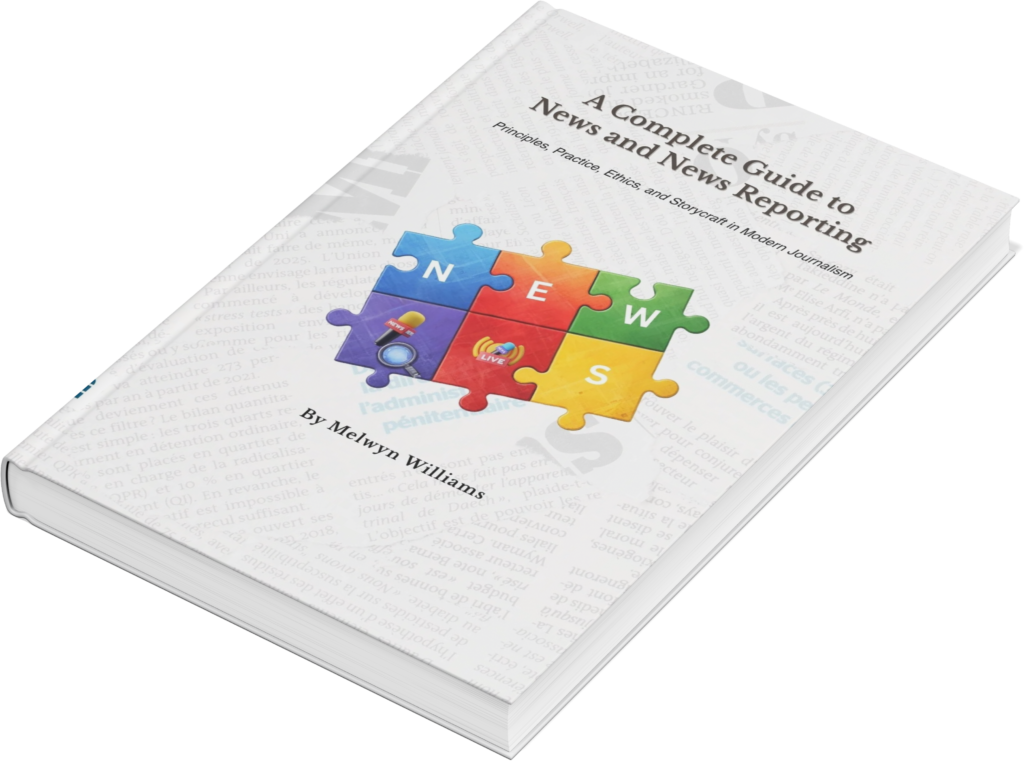
A Complete Guide to News and News Reporting
By Melwyn Williams
Journalism is changing faster than ever, yet its purpose has never been more essential. In a world saturated with information, noise, and digital distortion, the journalist remains the last line of clarity, credibility, and civic truth. A Complete Guide to News and News Reporting was born from this conviction: that journalism is not merely a profession, but a public trust that must be taught with rigor, practiced with integrity, and preserved with care.
Across nine comprehensive chapters and fifty-six structured parts, this book offers a full journey through the craft of reporting. It begins where journalism itself begins: with the question of what counts as news and why it matters in society. From there, readers move through the identity and responsibility of the journalist, the architecture of compelling storytelling, the mechanics of interviews, beats, and headlines, and the realities of legal and ethical constraints in the field.
Each section combines real-world insight with classroom-ready clarity. Whether you are a journalism student encountering news values for the first time, an educator shaping a curriculum, or a working reporter seeking to refresh your fundamentals, you’ll find here a roadmap grounded in decades of professional experience. The writing is practical without losing depth, ethical without being didactic, and modern without abandoning the timeless principles that uphold the craft.
This book is also deeply human. It speaks to the courage required to stand firm in a “post-truth” era, the empathy needed to interview people at their most vulnerable moments, and the discipline necessary to report fairly under pressure. Accompanied by a workbook and teaching resources, the text is designed for both self-study and institutional adoption.
Journalism does not survive on technology, it survives on journalists.
This guide aims to prepare them. This can be a handbook to anyone on the block
Know Click to Know More…




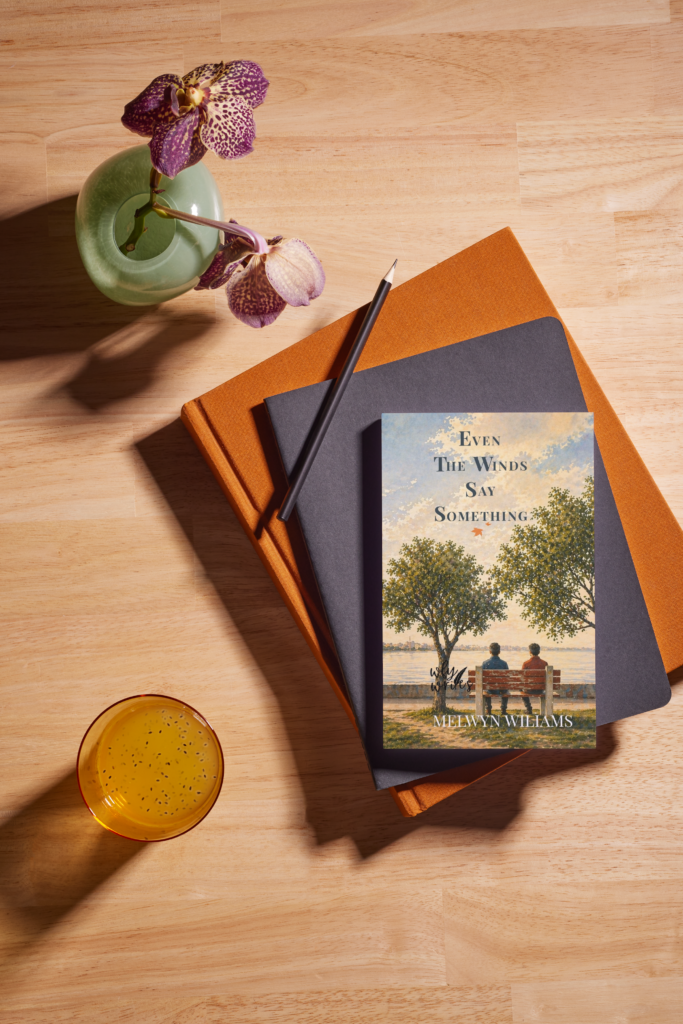

Even The Winds Say Something
By Melwyn Williams
The story unfolds over the course of a single evening by a lakeside promenade in a North Indian city.
As daylight thins and the evening gathers, the lake fills with people. Vendors arrive with their carts. Families drift in. Couples walk without hurry. The place is ordinary, familiar, and quietly burdened with stories that are never spoken aloud.
Amar Sharma arrives alone. He moves through the space as if he belongs to it, observing without stopping, keeping a careful distance from the water. His movements are deliberate, repetitive. He pauses at certain points, then moves on. Nothing about him draws attention.
Umar Khan enters from another side. He stops at the gate, watches people before the lake, sits for a while, then begins to walk. His phone vibrates at intervals, though no one ever seems to be calling. He silences it without explanation and continues moving, as if time itself needs managing.
The two men do not notice each other at first. They circle the same paths independently, returning to the same railings, benches, and steps, each measuring the evening in his own way.
A sudden public commotion interrupts the rhythm. A young couple is stopped from jumping into the lake. The crowd gathers quickly, phones raised, voices overlapping with concern, curiosity, and indifference. The couple is pulled back, given water, spoken to, and taken away by the police. The crowd disperses just as quickly, returning to tea, conversation, and walking.
Amar and Umar witness the incident from different distances. Neither speaks. Something shifts in both of them.
Later, at a crowded tea stall, circumstance forces them to share a table. The exchange begins without intention. Small talk. Observations about the place. Neutral remarks that reveal nothing. Yet each becomes quietly alert to the other’s pauses, his hesitations, his way of staying.
They begin walking together. Not as companions, not as friends, but as two people refusing to leave the other alone. Neither asks questions that would demand answers. Neither admits why he is there. Instead, they talk about films, old songs, places that no longer exist. They observe strangers passing by, diagnosing lives with gentle humour. For the first time in a long while, laughter arrives without warning.
Suspicion grows alongside care. Each man believes the other might be standing on the edge of something dangerous. Each responds not with confrontation, but with company. They try, politely, to send the other home. Each refuses, for reasons left unsaid.
When separation finally becomes inevitable, one follows the other into a darker stretch of the path. There is no confession. No naming of intent. Only mutual recognition, carried through action rather than words.
By the end of the night, phone numbers are exchanged. Promises are made casually, without ceremony. A simple message arrives on a phone that had long been silent.
They leave the lake separately. The world resumes its pace. Nothing has been solved. Nothing has been fixed.
But for one evening, two people are not alone.
And that is enough.
This story came quietly.
It did not begin with a clear plan or a fixed direction. It arrived in fragments. A place. An evening. A sense of stillness that felt familiar but difficult to explain. Over time, these fragments stayed, returning again and again, until they found their place on the page.
At its centre is something simple. Two individuals, a shared space, and the time they spend without fully knowing why they have come there. Nothing extraordinary happens. And yet, something shifts.
This book does not try to explain everything. It does not offer answers or conclusions. It stays with moments as they are, allowing them to remain incomplete where they need to be.
Some stories move forward through events. This one moves through presence.
If you choose to stay with it, take your time.

Start Small, Start Real
By Melwyn Williams
Most people do not begin thinking about business because they dream of becoming entrepreneurs. The idea usually begins more quietly.
It starts with a simple thought:
“I need something extra.”
Not a huge company or a dramatic life change. Just something steady. Something reliable. Something that creates a little more financial freedom and control over the future.
A second income often begins as a practical need, not a grand ambition.
You may already have a job, responsibilities and limited time. The goal is not to replace your life overnight. The goal is to build something alongside it, slowly, safely and realistically.
So the real question becomes:
What kind of side income actually makes sense?
Something easy to begin.
Something affordable.
Something people already need every day.
That is where cleaning products become interesting.
They may not sound exciting at first. People rarely talk about dishwashing liquid or floor cleaner as business opportunities. But if you observe everyday life carefully, you notice one important truth:
cleaning never stops.
Homes constantly need floor cleaners, dishwash liquids and bathroom products. These are not trend-based products. They are used continuously, week after week, in every household.
That consistency is what makes this business practical.
You are not trying to create demand from nothing. The demand already exists. Your role is simply to enter a market people already depend on.
This book focuses on building a small-scale cleaning product business that can start from home and gradually grow into a dependable second income.
The emphasis throughout this book is realism.
You will not find promises of instant success or complicated corporate strategies. Instead, you will learn practical steps for starting small, including:
- understanding how the cleaning product market works
- choosing beginner-friendly products
- creating simple production systems without heavy investment
- finding early customers naturally
- building repeat sales that create steady income over time.
This book is written for people with real-world responsibilities, jobs, families and limited starting capital. It is not about taking reckless risks. It is about building something practical alongside your current life.
And before moving forward, one important idea must be understood:
starting small does not mean thinking small.
A modest beginning is often an advantage. Small batches and simple systems allow you to learn, improve and grow without overwhelming pressure or costly mistakes.
Many people assume they need expensive equipment, technical expertise or large-scale operations to succeed. Others feel discouraged by big brands already in the market. But small businesses compete differently, through local trust, relationships, consistency and sensible pricing.
Throughout this journey, one idea will appear again and again:
simplicity creates stability.
The strongest small businesses are usually not the most complicated ones. They are built step by step by people who focus on clear products, understand their customers and improve steadily over time.
Progress may feel slow at times. That is normal. Reliable income grows through consistency, not sudden breakthroughs.
You are not trying to build a perfect business from day one.
You are building a system that improves with experience.
And if you approach the process patiently, this is something anyone can begin.
So let us start by understanding why cleaning products, despite their ordinary appearance, can become one of the most practical paths toward a steady second income.